

Updates
July 9, 2026: The Maine Forest Service is seeking small landowners who may be interested in participating in the 2026-2027 Early Intervention Strategy Program for spruce budworm. If you think you are interested, submit their landowner interest form on their Spruce Budworm website (maine.gov/sbw).
- Learn more at an upcoming event: “News & Events“
- Read more under “Maine Forest Service Seeking Small Landowners for 2026-2027 No Cost Treatment Opportunity“.
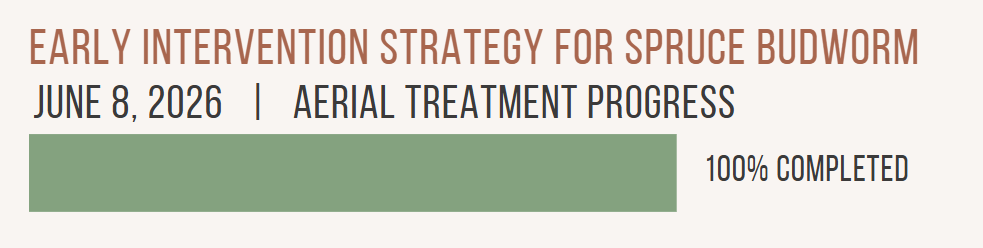
June 8, 2026: Treatments for the Early Intervention Strategy Program have been completed in all areas.
Read more information about insecticides, treatment areas, and Early Intervention Strategy below.
Early Intervention Strategy 2026
The main goal of Early Intervention Strategy Program (EIS) is to help maintain healthy trees by using targeted insecticides to reduce building populations of spruce budworm before they outbreak to prevent significant tree damage and mortality. EIS can help protect the health of our forest ecosystems and resources, maintain wildlife habitat, and prevent impacts to our forest-based economy.
Following the success of the EIS approach last year (Read more details on last’s years program “2025 Aerial Spray Program“), land managers in the Maine Budworm Response Coalition (MBRC) chose to use the EIS approach again in 2026 to reduce elevated populations of spruce budworm and prevent an outbreak. This year, the Maine Forest Service worked with small landowners who also participated in the EIS program.
The Maine Forest Service and the University of Maine Spruce Budworm Lab monitor spruce budworm (SBW) populations in Maine and the northeast to detect potential outbreaks before they happen. When SBW populations are elevated, natural enemies can no longer keep the SBW populations low and stable. Continued monitoring and L2 surveys during the Winter 2025-2026 season revealed roughly 83,000 acres of forestland with elevated populations of spruce budworm – a significant decrease compared to the hot spots present the year before.
Of the areas with elevated budworm populations, approximately 70,000 acres of forestland were identified for potential treatments in late May and early June 2026 using targeted insecticides.
Which insecticides were used in 2026?
The same insecticide products that were used last year were used again this year: tebufenozide (Mimic) or Btk (Bacillus thuringiensis kurstaki, Foray 76b). These insecticides were applied by helicopter using modern technologies to ensure accurate applications.
These insecticides were chosen specifically because they only affect caterpillars that feed on the treated foliage and both break down naturally through sunlight and microbes present in the forest. Read more about the active ingredients:
Applications from the helicopter were only be applied:
- On the tops of spruce-fir forest with spruce budworm populations that are near or above the action threshold
- On woodlots that were officially enrolled in the Early Intervention Strategy Program by their landowners
- No closer than 100 ft from lakes, streams, other bodies of water, and 1/4 mile from identified habitat of state-endangered, threatened, and/or species of special concern
- In good weather (no rain or high winds) to prevent drift or unintended applications
- Using reduced-risk insecticides (tebufenozide or Btk) that only affect larvae that eat treated foliage.
Where were insecticides applied?
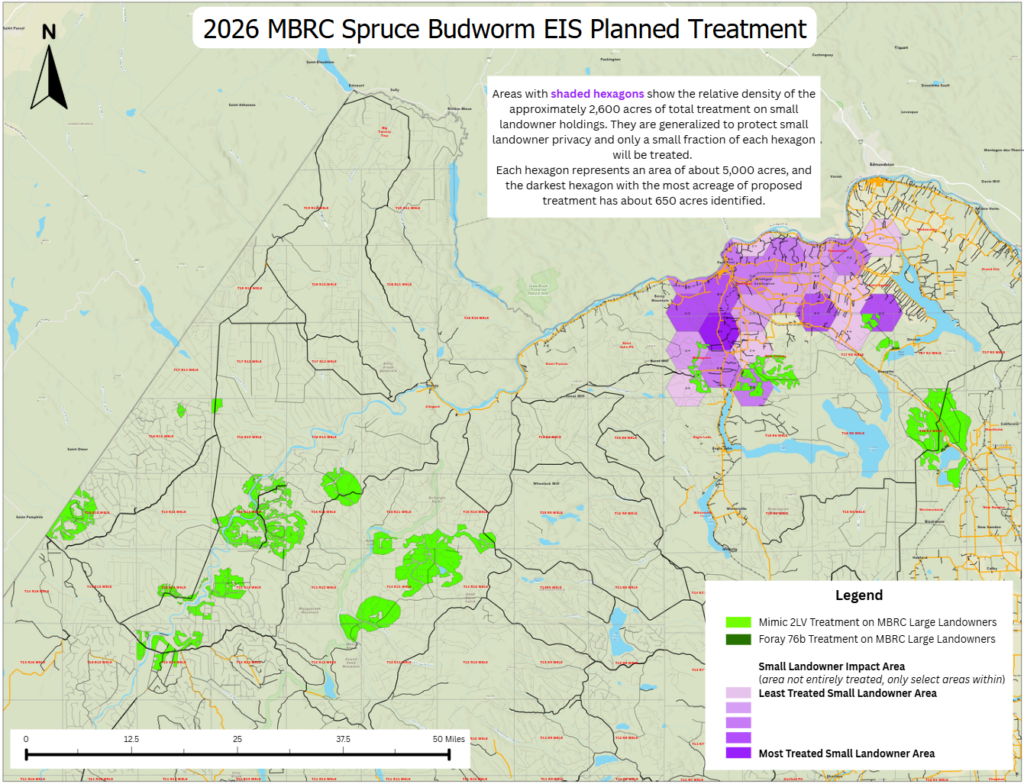
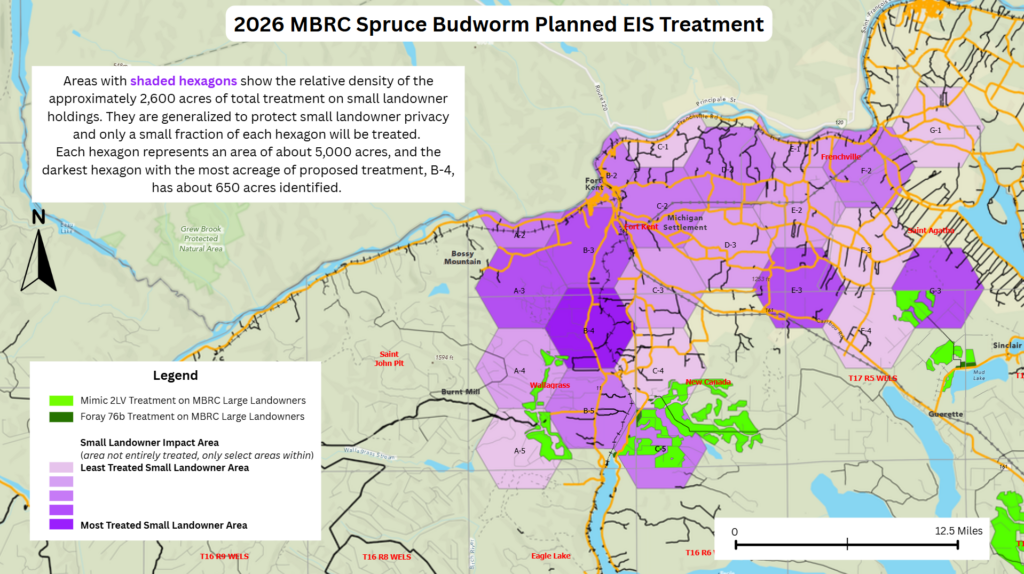
The majority of the 2026 Early Intervention Strategy management occurred in Northern Aroostook County. Insecticide products were applied to the tops of spruce and fir dominant stands that had elevated populations of spruce budworm. Treatments started on June 3 and were completed on June 8, 2026.
Treatments were only applied to forested areas that were officially enrolled in the program by their landowners.
Planned treatment maps are available below.
For more information about treatment locations, email mainebudwormrc@gmail.com
Still have questions about spruce budworm or the EIS response?
We’re here to help. Multiple organizations are involved in the monitoring, research, and response to building spruce budworm populations. Find contacts on our contact page: