


MAINE FOREST SERVICE: In 2026, the EIS approach continued to play an important role in maintaining the health of Maine’s spruce-fir forests. Thirty-eight small woodland owners voluntarily enrolled 127 woodlots in the 2025-2026 EIS program through the Maine Forest Service to share in the success at no cost to them. This coordinated effort resulted in the treatment of approximately 2,600 acres on small landowner holdings where spruce budworm populations were building.
The reduction in total acres treated this year compared to the previous year is an encouraging win for EIS – it means treatments in 2025 contributed to fewer budworm hotspots to manage. Looking ahead, additional funding is available to support another small landowner EIS program for spruce budworm in 2027 at no cost to participants.
If you own a spruce-fir dominated woodlot in northern Maine and are interested in this opportunity in 2027, please complete the interest form on the Maine Forest Service website at your earliest convenience.
The continued success of this EIS is a landscape-level effort and is more effective when neighbors work together. Landowners are encouraged to talk to their neighbors about this opportunity, as connected spruce-fir forests across ownerships are more likely to meet minimum program requirements and lead to efficiencies in management.
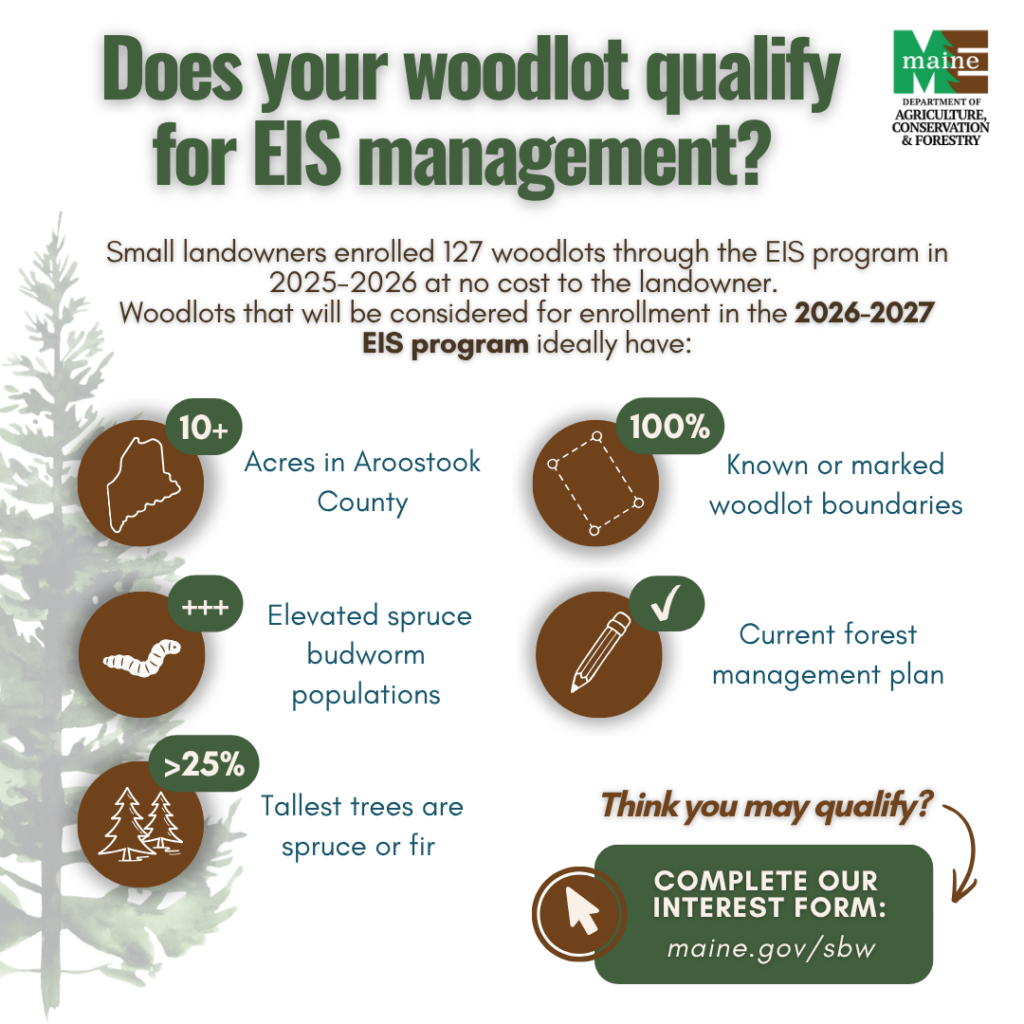
Woodlots that will be considered for enrollment will ideally have:
- At least 10 acres of treatable balsam fir or spruce dominated forest,
- Woodlots with mixed-wood stands with spruce-fir comprising at least one quarter of the tallest trees (co-dominant or dominant) will be considered for enrollment,
- Treatments may occur on smaller blocks depending on the distribution of other treatable areas,
- Preference for those woodlots with a stand map developed or certified by a licensed professional forester with accompanying details on forest composition,
- Known woodlot boundaries,
- Location within or immediately adjacent to the 2027 area modeled to have spruce budworm populations exceeding management thresholds (2026 data can be found at www.sprucebudwormmaine.org),
- Treatable areas that are not within habitat buffers of lepidoptera of special concern (which may include threatened, endangered and rare butterflies and moths) and other sensitive areas such as areas with open water and bald eagle nests.
- Christmas tree plantations will not be considered for enrollment.
More information about spruce budworm, the EIS program, insecticide treatments, and 2024-2025 EIS results are available on the Maine Forest Service website: www.maine.gov/sbw.